
Imagine stepping into a hot shower on a cold morning, only to be greeted by a blast of icy water because your tank heater ran out. If you have a large family or multiple bathrooms, you know the struggle of waiting for the tank to refill and reheat. Gas tankless water heaters solve this problem by heating water on demand, providing an endless supply of hot water. In this guide, we review the best gas tankless water heater brands of 2026, covering top models from A.O. Smith, Rheem, Rinnai, ThermoMate, and more, to help you find the perfect unit for your home.
Whether you need a high-capacity unit for a whole-house setup or a compact model for a small apartment, we have you covered. Our picks are based on performance, energy efficiency, durability, and customer satisfaction. For a broader look at top options, check out our best gas tankless water heater roundup.



Buying Guide: How to Choose the Right Gas Tankless Water Heater
Selecting the right gas tankless water heater involves more than just picking a popular brand. You need to consider your home’s hot water demand, installation location, and energy efficiency goals. Here are the key criteria we used to evaluate the models in this review.
Flow Rate (GPM) and BTU Output
The flow rate, measured in gallons per minute (GPM), indicates how much hot water the unit can deliver at a specific temperature rise. A higher GPM is essential for homes with multiple simultaneous showers. BTU output determines the heating capacity; higher BTUs allow for a greater temperature rise, which is crucial in colder climates.
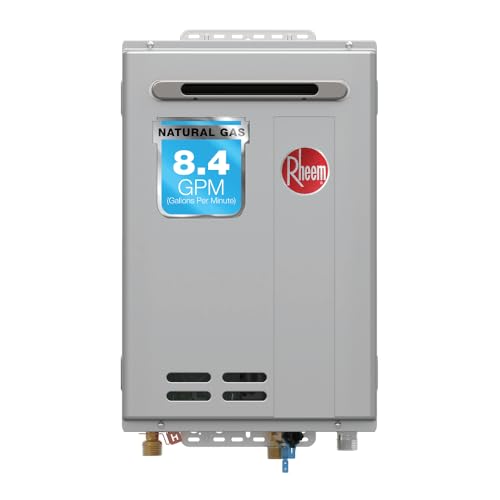
For a typical household with two to three bathrooms, a unit with 7 to 8 GPM is often sufficient. For larger homes, consider models with 8.4 GPM or more, like the Rheem RTG Series 8.4 GPM. For a detailed guide on sizing, see our best tankless water heater for whole house article.
Energy Efficiency (UEF Rating)
Uniform Energy Factor (UEF) measures how efficiently a water heater converts energy into hot water. Higher UEF ratings mean lower operating costs. Condensing units typically have UEF ratings above 0.90, while non-condensing models range from 0.80 to 0.85. For maximum savings, look for condensing models like the Rinnai RX199iN with a UEF of 0.98.
Energy-efficient models can save you up to 34% on energy costs compared to traditional tank heaters. For more on efficiency, explore our best tankless water heater brands guide.
Indoor vs. Outdoor Installation
Decide where you will install the unit. Outdoor models are vented directly to the outside, saving indoor space and eliminating the need for complex venting. Indoor models require a venting system (PVC or stainless steel) and may need more clearance. Some models, like the Rinnai RX199iN, offer versatile installation options with the appropriate vent kit.
If you prefer an outdoor unit, check out our best outdoor tankless water heater picks. For indoor units, ensure you have proper ventilation and access to a gas line.
Warranty and Long-Term Reliability
A solid warranty protects your investment. Look for a minimum of 10 years on the heat exchanger and 5 years on parts. Some brands, like A.O. Smith and Rheem, offer up to 15 years on the heat exchanger. Also, consider the brand’s reputation for durability and customer support.
Reading verified customer reviews can provide insight into real-world performance and reliability. For a comprehensive look at top-rated models, see our best tankless water heater overview.
Final Thoughts
Choosing the right gas tankless water heater depends on your home’s specific needs, budget, and installation preferences. For a high-capacity, efficient unit that can handle multiple showers, the Rheem RTG Series 8.4 GPM Natural Gas Tankless is an excellent choice. If you need a compact, budget-friendly option for smaller homes, the ThermoMate CZ422NG, Natural Gas Tankless Water offers reliable performance without breaking the bank. Both models represent the best of their respective categories, ensuring endless hot water for years to come.
Frequently Asked Questions
What is the lifespan of a gas tankless water heater?
Gas tankless water heaters typically last 20 years or more, compared to 10-15 years for traditional tank heaters. With proper maintenance and regular descaling, you can extend their lifespan even further. This longevity makes them a cost-effective investment in the long run.
Can a gas tankless water heater supply hot water to multiple bathrooms at once?
Yes, but the capacity depends on the unit’s flow rate (GPM) and BTU output. Models with 8 GPM or higher can handle 3-4 simultaneous showers. For larger homes, consider a condensing unit like the Rinnai RX199iN, which delivers up to 11.1 GPM. Check our best gas tankless water heater for large home for more options.
Are gas tankless water heaters more energy-efficient than electric ones?
Gas tankless water heaters generally have higher energy efficiency (UEF) than electric tankless models, especially in colder climates where electric units struggle to heat water quickly. They also have lower operating costs if natural gas is cheaper than electricity in your area. However, electric models may be more efficient in mild climates.
Do gas tankless water heaters require special venting?
Yes, indoor gas tankless water heaters require a venting system to exhaust combustion gases. Non-condensing models typically use PVC or stainless steel venting, while condensing models can use smaller diameter PVC. Outdoor models do not require venting, as they are installed outside. Always follow the manufacturer’s specifications for safe installation.